What Emerging Experience Economies Reveal About Destination Stewardship
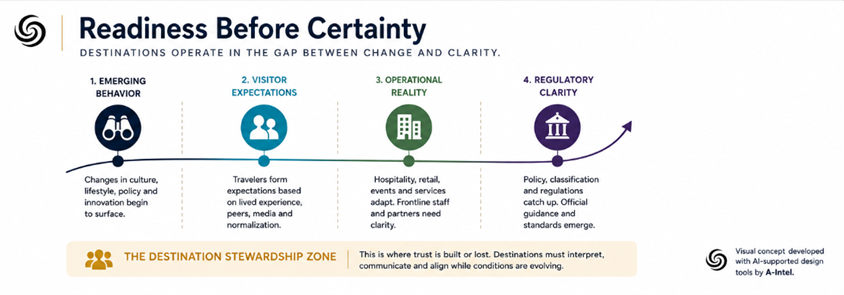
Destinations are entering a period where change is moving faster than traditional planning cycles were designed to absorb.
Visitor expectations are evolving in real time. Artificial intelligence is beginning to reshape hospitality systems. Wellness, regenerative travel, accessibility, and transformation-oriented experiences are becoming more visible across the visitor economy. Increasingly, destination organizations are being asked to navigate emerging realities before clarity fully arrives.
The challenge is no longer simply responding to change.
It is creating understanding while conditions are still evolving.
That is the stewardship challenge emerging beneath the modern experience economy.
The destinations best prepared for the next decade will not necessarily be the ones that move the fastest. They will be the ones that develop the capacity to interpret emerging realities early, communicate clearly under uncertainty, and maintain trust across residents, stakeholders, and visitors while conditions are still unfolding.
In that sense, readiness itself is becoming a core destination capability.
Emerging Experience Categories as Signals
Emerging experience categories often reveal more about destination systems than they do about the category itself.
One of the clearest ways to observe this shift is through emerging experience categories that intersect policy, culture, commerce, wellness, and identity all at once.
Cannabis is one example.
Not because cannabis is uniquely important in isolation, but because it functions as a revealing diagnostic lens for destination systems.
Cannabis touches public policy, hospitality, resident sentiment, wellness travel, events, workforce considerations, cultural identity, regulation, and visitor expectations simultaneously. As a result, it exposes how effectively destinations coordinate communications, governance awareness, and stakeholder alignment under conditions of uncertainty.
Importantly, this is no longer theoretical.
Across North America, cannabis and hemp are already embedded in the visitor economy in varying forms — through wellness travel, agricultural heritage, events, experiential hospitality, and broader lifestyle normalization. Travelers increasingly arrive with expectations shaped by lived experience and regional realities rather than federal posture alone.
Recent federal movement toward Schedule III reclassification in the United States reflects a broader institutional shift. Regardless of the ultimate policy outcome, the conversation itself signals continued movement away from prohibition-era assumptions and toward new forms of public, regulatory, and market consideration.
For destinations, the significance is less about cannabis itself than about what this moment reveals.
It reveals whether destination systems can hold complexity without fragmenting trust.
Stewardship Versus Promotion
This distinction matters.
Destination stewardship is not advocacy. It is not promotion. And it is not about moving ahead of communities.
Stewardship is the ability to notice emerging realities early, contextualize them responsibly, and help stakeholders build shared understanding before uncertainty hardens into reputational or operational risk.
Stewardship increasingly requires the ability to create understanding before certainty arrives.
In practice, this means destinations increasingly need the capacity to:
- interpret evolving visitor behavior before formal policy fully catches up
- distinguish observation from endorsement
- communicate clearly across stakeholders with differing expectations
- understand how emerging experiences intersect with resident quality of life
- maintain coherence between destination identity, governance realities, and visitor expectations
These are not cannabis-specific skills.
Cannabis simply makes the gaps visible.
The same dynamics are emerging across regenerative travel, AI-enabled hospitality, accessibility, climate adaptation, and evolving cultural travel categories.
Stewardship in a Period of Transition
Increasingly, destination organizations are being asked to function not simply as marketers, but as stewards of place operating within dynamic social, economic, technological, and cultural conditions.
That shift requires new forms of Stewardship Intelligence.
Not intelligence as prediction.
But intelligence as orientation.
Stewardship Intelligence is the practice of integrating diverse forms of intelligence in service of community vitality.
The ability to establish a grounded understanding of what exists, why it matters, how conditions are evolving, and what implications may emerge across the broader destination system.
Across the visitor economy, conversations surrounding artificial intelligence, regenerative travel, accessibility, climate adaptation, wellness, and other emerging experience categories are already accelerating.
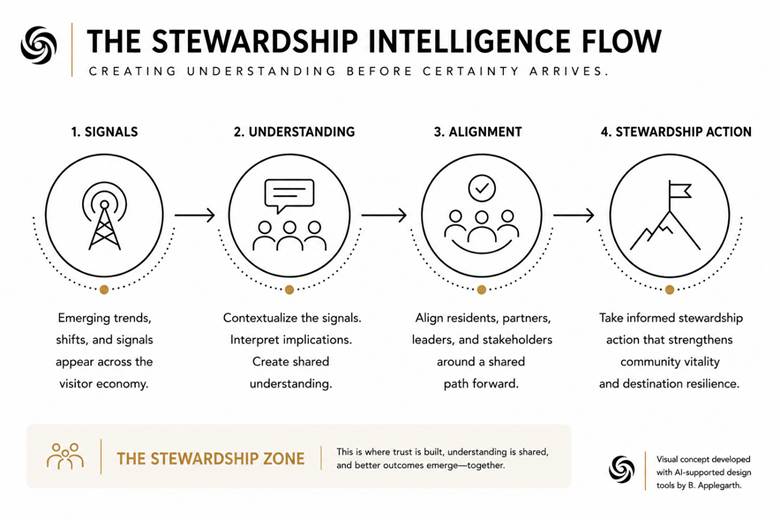
The question is not whether change will continue.
The question is whether destination systems can create understanding, alignment, and trust while that change is still unfolding.
Because ultimately, the future challenge for destinations is larger than any single category.
It is about developing the capacity to steward complexity without losing coherence, credibility, or community trust.
Stewardship increasingly requires the ability to create understanding before certainty arrives.
And that may become one of the defining destination capabilities of the next decade.
About the Author
Brian Applegarth is founder of Applegarth Intelligence, a stewardship intelligence practice focused on helping destinations navigate change through the lenses of community vitality, place identity, governance readiness, and long-term stewardship.
He is co-author of the first-ever Cannabis Travel Audience research conducted within MMGY Global's Portrait of the American Traveler platform and author of Learning Under Pressure: Setting a Baseline for Stewarding Places Through Change.
His current work explores how destination systems create understanding, alignment, and trust during periods of social, technological, and economic transition.